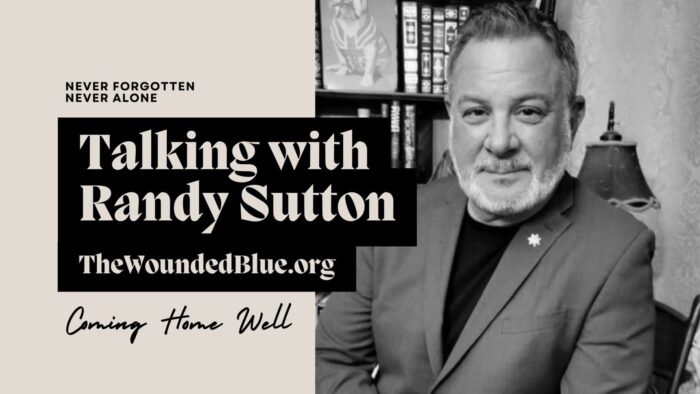
From First Responder to Founder: How Randy Sutton Built The Wounded Blue
When Randy Sutton joined the Las Vegas Metropolitan Police Department after a six-year stint in Princeton, New Jersey, he envisioned a career defined by service and a clean retirement. He never imagined that his 34-year legacy would culminate in the front seat of a cruiser on the Las Vegas Strip, witnessing his own body fail him.
“I literally felt my brain slowing down,” Randy recalled in a recent episode of Coming Home Well with Dr. Tyler Pieron. “I knew what was happening. I knew I was having a stroke.”
What followed wasn’t just a medical crisis; it was a systemic betrayal that would ultimately drive Randy to create one of law enforcement’s most vital lifelines: The Wounded Blue.
A Career Cut Short, A System That Failed
Randy survived the stroke, but the physical toll on his heart meant his days on patrol were over. However, the real shock came from the department he had served for 24 years. Instead of support, he met resistance.
“My own department turned its back on me and just said, ‘We’re not paying your medical bills and we’re not giving you your benefits.’ That feeling of betrayal — what happened to that brotherhood I perceived for all these years?”
In Nevada, heart disease is legally considered an automatic workers’ compensation injury for first responders. Yet, Randy spent over a year fighting a third-party administrator hired to deny claims. As legal fees mounted and bill collectors circled, the “Blue Wall” felt more like a barrier than a brotherhood. Randy eventually won his case, but the experience exposed a national crisis: Officers were being treated as disposable.
Born From Crisis: The Wounded Blue
Randy wasn’t just another officer; he was a recognizable face from the TV show COPS and films like Casino. Because of his visibility, he became a lightning rod for stories of abandonment from across the country.
Messages poured in from officers who had been shot, stabbed, or beaten in the line of duty, only to be cast aside by their agencies. The common thread was heartbreaking: “I feel forgotten. I feel alone.”
In 2018, Randy founded The Wounded Blue with a simple, non-negotiable motto: Never Forgotten. Never Alone.
Impact by the Numbers
Since its inception, the organization has become a powerhouse of advocacy:
17,000+ officers helped nationwide.
7 Years of active service and peer support.
24/7 Hotline staffed exclusively by law enforcement peers.
Confronting the Hidden Epidemic: Suicide
The most sobering reality Randy faces is the rate of suicide among police officers. While FBI statistics are beginning to track these numbers more closely, the data suggests that officers are three to five times more likely to die by suicide than to be killed in the line of duty.
“There are no statistics for retired cops,” Randy noted. “Nobody even knows how many retired cops are killing themselves. But I know it’s a lot.”
Unlike the military, which has the VA and a massive network of veteran organizations, law enforcement, especially in small municipal departments, often lacks a safety net for those transitioning out due to injury or trauma.
Resources: How to Get Help
The Wounded Blue provides a bridge to recovery through peer-to-peer support, legal advocacy, and mental health referrals.
24-Hour Hotline: Answered around the clock by a fellow officer. If you call, you aren’t talking to a clinician; you’re talking to someone who has worn the badge.
The National Law Enforcement Survival Summit: Held every September in Las Vegas (this year at Palace Station Hotel, Sept 28–30), this event has been credited with literally pulling officers back from the brink of despair.
Online Support: Visit thewoundedblue.org or follow them on social media @TheWoundedBlue.
Final Thought
Randy Sutton’s journey from a stroke on the Strip to a national founder is a testament to the fact that the mission doesn’t end when the uniform comes off.
As Randy puts it: “When people need help, they call 9-1-1. When the police need help, they call the Wounded Blue.”
To hear Randy’s full story, listen to the full episode of Coming Home Well with Dr. Tyler Pieron.
